Showing posts with label 1930. Show all posts

Thursday, 11 July 2013

1930 - The School Yard

The School Yard 1930
Pencil
27.5 by 38 cm
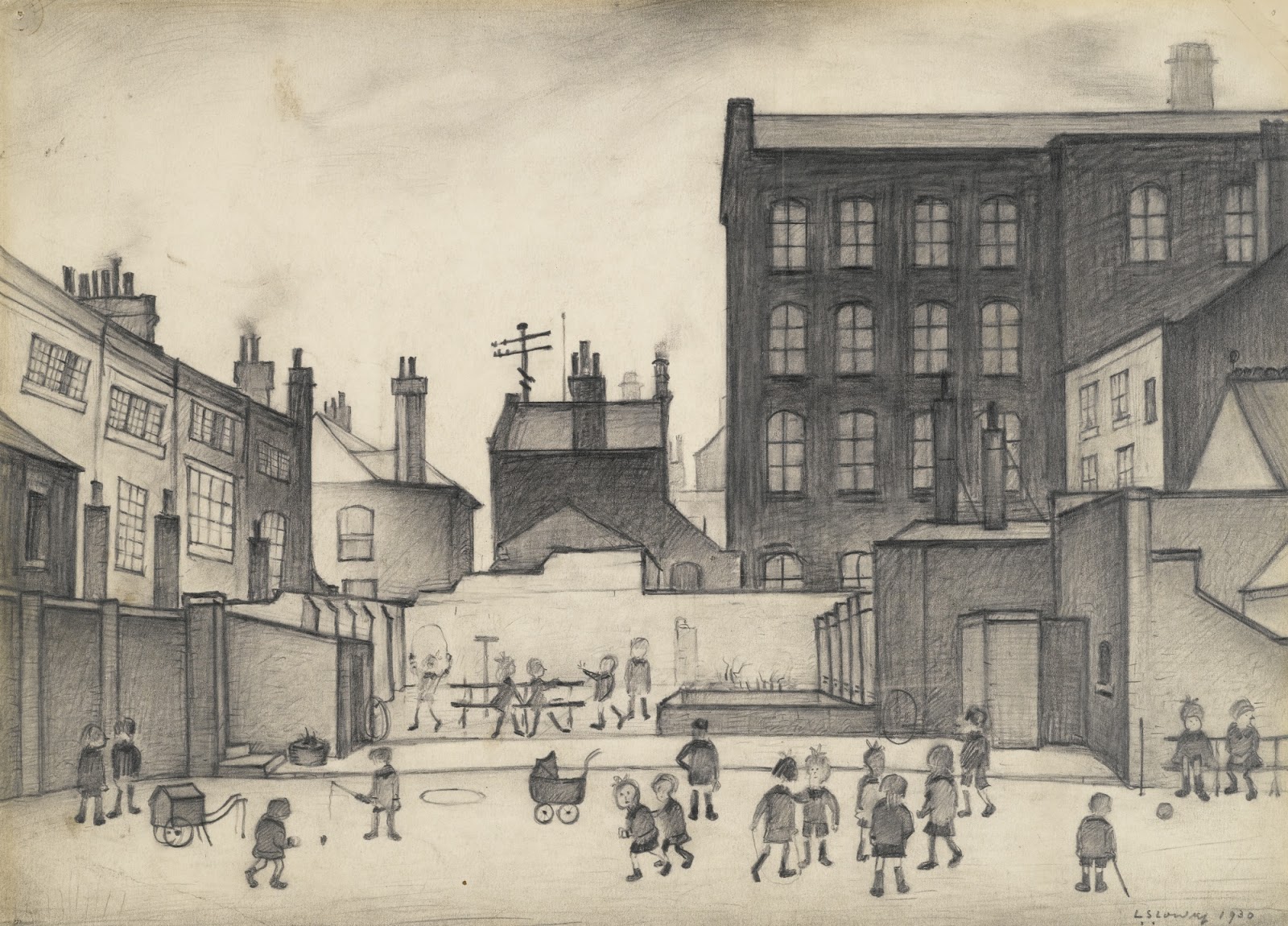
Signed and Dated 1930

Provenance
Acquired by the previous owner in 1954

Notes
If any were to doubt Lowry’s capacity as a draughtsman, they could do no better than study the group of drawings he produced in the 1929-30 period. Do that, and one would be very hard pressed to deny him a very particular mastery of the pencil.

Drawing was always a key element to his working method. It was the basis of his technique, hard-won through many hours of study in the life room of the Salford Art School, models clad and semi-clad, some in costume, teasing out his understanding of the human figure. It gave him an instant form of record for the scenes he saw in the streets, jotted onto the backs of envelopes or the sheets of a pocket note-book. It allowed him the expansive exploration of those same ideas, building a world in graphite, a medium that echoed the gritty muck of its subjects.

The earliest drawings away from the life-room were perhaps a little stilted, stiff little groups of figures, scored into the paper with an even hard point. Gradually, as the 1920s progressed, he learned the tricks of the medium. As learning a language is so much more than just the words and grammar, Lowry developed the nuances of the pencil, learnt to twist it to his own ends, use the thick blunt line from a soft lead to give substance and structure to a factory building, rub a feather-stroke away with the edge of a thumb to make it the wisp of the first coal smoke of the morning drifting from the chimneys of a terrace. Most importantly, he learnt the most important trick of the great draughtsman, to bring colour from black and white, to make the impression of the subject so intense and convincing that our own brain does the rest. Suddenly we understand the shade and texture of the worn, weathered paint on a tenement door, the grubby grey of paving flags. How? Because Lowry makes the experience feel real. At his best he goes beyond this, letting us even hear and smell the scene. The chatter of shawled women queuing outside a shop, the shouts of children bouncing off brick alleys, the acrid smell of the factories and the chimneys, the dank stink of canal or river.

In March of 1930, Lowry held a very short exhibition. For two days only, ‘A Collection of 25 Pencil Drawings of Ancoats made by Mr L.S.Lowry’ was shown at the Round House, Every Street, Manchester. The drawings shown include some of Lowry’s finest, subtle studies that evoke the streets, factories and back alleys of this industrial neighbourhood. They tread the fine line between literal representation and nostalgic recollection. They recognise the flaws, the dirt, the poverty, but they neither preach nor sentimentalise. They simply feel real; real places, real lives, real spaces. By 1930, when he produced the present work, Lowry had brought his drawing style to a height of achievement that is truly remarkable.

Wednesday, 10 July 2013

1930 - Beech Cottage, Romiley

Beech Cottage, Romiley 1930
Pencil
19 x 27.5 cm. (7 1/2 x 10 3/4 in.)
Sold [March 2009] for £9,600 including premium
Signed and Dated 'L S Lowry 1930' (lower right)
Inscribed 'Beech Cottage/Romiley' (verso)

PROVENANCE
Possibly with The Lefevre Gallery, London

Beech Cottage is located in Romiley, Stockport.

Monday, 8 July 2013

1930 - Almshouses at Northleach

Almshouses at Northleach 1930
Pencil
26.5 x 18.5 cm
Sold [May 2013] for £23,750 including premium
Signed and Dated 'L S Lowry 1930' (lower right)

PROVENANCE
Harold and Edith Timperley
Thence by descent

The present and following lot are from a series of illustrative depictions of idyllic views by Lowry produced for Harold Timperley's topographical survey A Cotswold Book. This commission, amongst the artist's earliest, came at the suggestion of Harold's wife Edith who was ever so fond of Lowry and felt it would be good to encourage her friend; "In those days he (Lowry) would get enormously depressed. On one such occasion, when he was particularly low, I persuaded Harold to ask Lowry to do the drawings for his Cotswold Book." (Edith Timperley in Shelley Rhode, L.S. Lowry; A Biography, Lowry Press, Salford, 1999, p.171).

A Cotswold Book reproduced twelve of Lowry's drawings, but it is known by exhibition records from The Bury Art Gallery, 1962 that further works were produced, includingMangersbury (1930, Private Collection) and presumably also the present work Almshouses at Northleach.

Harold and Edith Timperley can be counted amongst Lowry's closest friends and confidants from this period and for many years to come; indeed following the death of his mother in 1939 the Timperleys took the distraught Lowry in to their home, caring for him for three weeks whilst he recovered from his loss.

1930 - Crowther's Buildings, Ancoats, Manchester


 Crowther's Buildings, Ancoats, Manchester 1930
Pencil
38 x 28 cm
Signed and Dated 'L S Lowry 1930' (lower right)
PROVENANCE
Monty Bloom
Sale; Christie's, London, 6 November 1992, lot 113
Bath, Cleveland Bridge Gallery, where purchased by the present owner
Private Collection, U.K.

EXHIBITED
Sheffield, Graves Art Gallery, L. S. Lowry, An Exhibition of Paintings, Watercolours and Drawings, 15 September - 14 October 1962, no.143 (as 'Crowthers of Pin Mill Brow', where lent by Monty Bloom)
Sunderland, Sunderland Art Gallery, Arts Council of Great Britain, L. S. Lowry R.A., Retrospective Exhibition, 27 August - 17 September 1966, no.140 (where lent by Monty Bloom); this exhibition travelled to Manchester, Whitworth Art Gallery, 24 September - 15 October 1966; Bristol, City Art Gallery, 22 October - 12 November 1966; London, Tate Gallery, 22 November 1966 - 15 January 1967
Liverpool, Walker Art Gallery, L. S. Lowry, April - June 1973, no.28 (where lent by Monty Bloom)
London, Royal Academy of Arts, L. S. Lowry R.A., 4 September - 14 November 1976, no.98 (where lent by Monty Bloom)
Salford, Salford Art Gallery, L. S. Lowry Centenary Exhibition, 16 October - 29 November 1987 (where lent by Monty Bloom)

LITERATURE
Mervyn Levy, Drawings of L. S. Lowry, Jupiter Books, London, 1973, no.43 (ill.b&w)
Royal Academy, L. S. Lowry R.A., The Hillingdon Press, Uxbridge, 1976, no.98, p.61

In 1930 Lowry was invited to make a series of drawings of the Ancoats district of Manchester. They were displayed in the Ancoats Settlement, a club for working men. Crowther's Buildings have since been demolished.

1930 - Arlington Row, Bibury

Arlington Row, Bibury 1930
Pencil
18.5 x 26 cm
Sold [May 2013] for £34,850 including premium
Signed and Dated 'L S Lowry 1930.' (lower left)

PROVENANCE
Harold and Edith Timperley
Thence by descent

LITERATURE
H.W. Timperley, A Cotswold Book, Jonathan Cape, London, 1931, frontispiece facing p.246 (ill.b&w)
Shelley Rohde, L.S. Lowry; A Biography, Lowry Press, Salford, 1999, p.171 (ill.b&w)

For Lowry, the Timperley commission allowed him to indulge in uncharacteristically picturesque settings, concluding in a competent and academic series of mainly uninhabited scenes of rural and village Cotswold life worked up from photographic sources. In Arlington Row, Bibury, the final plate in A Cotswold Book, Lowry can't seem to resist the inclusion of a family of five linear figures making their way through the centre of the composition.

Arlington Row, Bibury, Gloucestershire, built in 1380 as a monastic wool store, is amongst the Cotswold's most recognisable views, not least due to its popularity as a frequently employed set for film and television. 

Avidly sought after whenever previously offered, four examples from the Cotswold series and related works have, at points, been in the esteemed collections of Ted Frape (former Director of the Salford Art Gallery), Andras Kalman (Lowry's dealer) and Selwyn Demmy (bookmaker and extensive Lowry collector).

1930 - Piccadilly, Manchester

Piccadilly, Manchester 1930
Pencil
27.5 x 38 cm
Sold [December 2003] for £33,460 including premium
Signed and Dated 1930 (lower right), also Signed, Titled and Dated (verso)

Sunday, 7 July 2013

1930 - The Organ Grinder

The Organ Grinder 1930
Pencil
37.2 x 27 cm
Sold [May 2013] for £151,250 including premium
Signed and Dated 'L S Lowry 1930' (lower left)

PROVENANCE
Acquired from the artist by the father of the present owner circa 1946
Please note this drawing was accompanied by four letters written by L.S. Lowry.

The Organ Grinder must surely rate as one of Lowry's most accomplished pre-war pencil drawings. Executed in 1930, it was the genesis for his applauded 1934 oil painting, An Organ Grinder, now in the prized collection of Manchester City Art Gallery (see Fig.1). When the two works are compared it becomes clear just how faithful the oil has remained to the work on paper. The only subtle differences are the positioning of a few of the figures and the buildings at the end of the receding street. The focal point of the picture remains constant and in the distance: the organ grinder. 

Appearing in the nineteenth century and remaining popular in England into the early twentieth century the organ grinder was almost always male and has been described as usually a casual labourer or vagabond. Some, owned their own barrel organs with which they travelled the urban landscape and played the repetitious tune of the machine in the hope a few spare coins would be tossed in their direction. The larger contraptions, as in Lowry's painting and drawing, were so large they were required to be mounted on a cart with wheels and pulled from street to street. 

In an article written the year before The Organ Grinder was drawn, the esteemed author George Orwell wrote an enlightening account of this poor mans' trade:

"To ask outright for money is a crime, yet it is perfectly legal to annoy one's fellow citizens by pretending to entertain them. Their dreadful music is the result of a purely mechanical gesture, and is only intended to keep them on the right side of the law. There are in London around a dozen firms specializing in the manufacture of piano organs, which they hire out for 15 shillings a week. The poor devil drags his instrument around from ten in the morning till eight or nine at night - the public only tolerates them grudgingly – and this is only possible in working class districts, for in the richer districts the police will not allow begging at all, even when it is disguised. As a result, the beggars of London live mainly on the poor.' (George Orwell, A Kind of Compulsion, 1903-36, p.134).